
More than 167 psychiatric patients have been evacuated from a hospital in South Kalimantan as weeks of wildfire smoke continue to deteriorate air quality across parts of Indonesia and neighbouring countries. Indonesia’s worsening wildfire crisis is putting additional pressure on the country’s health system, with authorities evacuating 167 psychiatric patients from a hospital in South Kalimantan as thick smoke increasingly affected the facility.
Officials are preparing an alternative location for the patients if conditions around the hospital become too hazardous for them to remain there, according to reports from Indonesian media.
The evacuation comes as health authorities record a sharp increase in respiratory illnesses linked to the wildfire smoke.
More than 170,000 respiratory cases have reportedly been recorded since August, ranging from relatively mild coughing and breathing difficulties to more serious conditions including pneumonia.
More than 40,000 of the reported cases involve toddlers, highlighting concerns about the impact of prolonged exposure to polluted air on young children.
Wildfires continue across Indonesia
Large fires have been burning across parts of Indonesia, particularly on the islands of Borneo and Sumatra, producing dense haze that has also affected neighbouring Malaysia and Singapore.
Air-quality readings in some affected areas have reached unhealthy levels as smoke from forest and peatland fires spreads across populated regions.
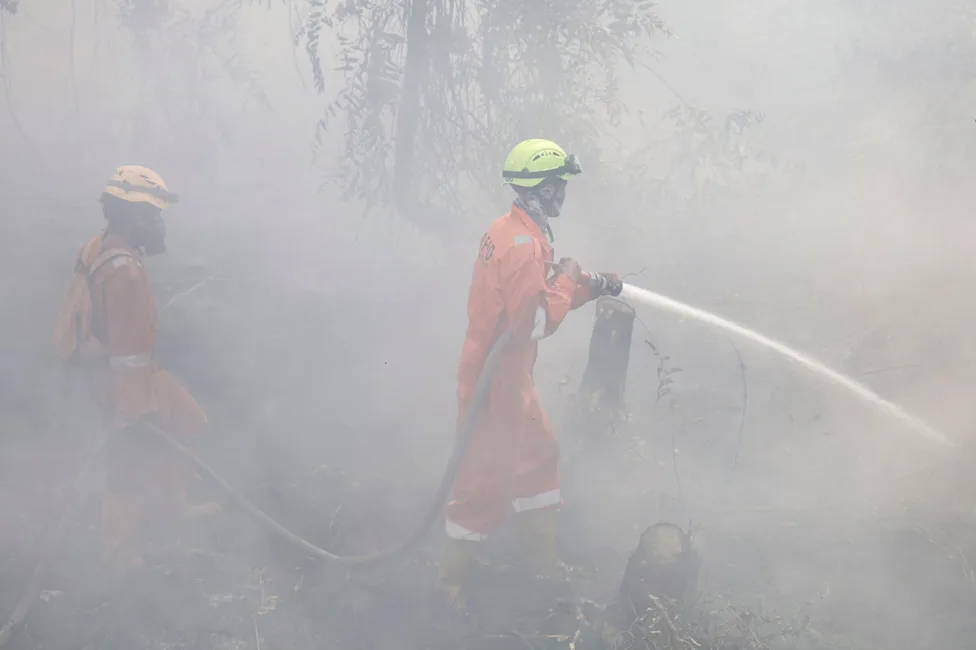
Indonesia has deployed more than 54,000 personnel, supported by dozens of aircraft involved in water-bombing operations, as authorities attempt to contain the fires.
Cabinet Secretary Teddy Indra Wijaya said government forces were continuing operations on the ground and from the air, with the stated priority of extinguishing fires, reducing smoke and protecting communities.
The scale of the affected territory, combined with the difficulty of fighting fires in peatlands, has complicated the response.
Nearly 900,000 hectares affected
The scale of the environmental damage is also becoming clearer.
According to the figures cited in the report, at least 895,657 hectares of land have burned since January — an area nearly six times the size of Greater London.
The independent forest monitoring platform Nusantara Atlas has also detected approximately 734,000 fire hotspots across Indonesia, reportedly more than 30% above the level recorded in 2019, one of the country’s worst wildfire years.
Peatland fires are particularly difficult to control because flames can spread beneath the surface and continue burning even after visible fires have been reduced.
El Niño adds to dry conditions
The wildfire crisis is occurring during Indonesia’s July-to-October dry season and has been intensified by an exceptionally strong El Niño climate pattern.
El Niño is associated with changes in atmospheric circulation and rainfall across different parts of the world. In Indonesia, strong El Niño conditions can contribute to hotter and drier weather, increasing the risk of fires.
The current event has produced unusually warm conditions in the tropical Pacific and is being closely monitored by international meteorological agencies.
The combination of prolonged dryness and vulnerable forests and peatlands has created conditions in which fires can spread rapidly and become difficult to extinguish.
Respiratory illness rises sharply
Indonesia’s health authorities have been monitoring the medical consequences of the haze.
Official figures cited in the report showed that the number of people suffering wildfire-related respiratory illnesses had already reached 113,336 by September 9, up from 50,891 on September 1.
The larger figure of more than 170,000 cases reported subsequently indicates that the health burden has continued to grow.
Smoke from vegetation and peat fires can contain fine particulate matter and other pollutants that penetrate deep into the respiratory system.
Children, older people and those with existing respiratory or cardiovascular conditions can be particularly vulnerable to prolonged exposure to polluted air.
Wildlife is also being affected
The fires are threatening wildlife as well as human communities.
Critically endangered orangutans in Borneo have been among the animals affected by the fires and smoke.
An orangutan found on a palm-oil plantation in West Kalimantan was reportedly rescued after being discovered in distress. The animal was treated for hypoxia but later died.
The incident has renewed concerns about the impact of recurring fires on one of the world’s most important habitats for orangutans.
Lawsuit filed over government response
The wildfire crisis has also generated legal and political pressure.
Indigenous and civil society organisations in West Kalimantan have filed a class-action lawsuit against Indonesia’s central government and local administrations, accusing authorities of negligence in their handling of the fires.
The groups argue that the recurring nature of Indonesia’s forest and land fires means authorities should have anticipated the risks and taken stronger preventive measures.
The allegations are contested claims made by the organisations involved in the lawsuit and have not, by themselves, established government liability.
Cloud seeding used to support firefighting efforts
Indonesia has also turned to cloud-seeding operations in an effort to increase rainfall in affected areas.
Several operations have been carried out in recent weeks, with Japan also providing assistance.
Japanese Self-Defense Forces personnel reportedly arrived in Borneo earlier in September to support firefighting efforts.
Neighbouring Malaysia has also conducted cloud-seeding operations in Sarawak.
Authorities there have been particularly concerned about water availability ahead of a forecast dry period in October. Sarawak deputy premier Douglas Uggah Embas said the objective was to increase water levels while conditions still allowed for it.
A regional crisis with wider implications
The Indonesian fires are not confined to the areas where they originate.
Smoke and haze can cross national borders, affecting air quality, transportation, public health and economic activity in neighbouring countries.
For Indonesia, however, the immediate challenge is managing a crisis affecting communities, hospitals, forests and wildlife simultaneously.
With the country’s dry season continuing and El Niño contributing to unusually dry conditions, authorities face a difficult race to contain the fires before conditions worsen further.
The evacuation of psychiatric patients from a hospital demonstrates how the crisis is moving beyond environmental damage and directly affecting essential public services.
As firefighting operations continue, authorities will also have to manage the growing public-health consequences of prolonged exposure to hazardous smoke while preparing for the possibility of further deterioration in October.

